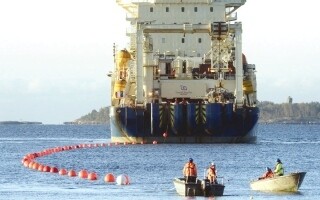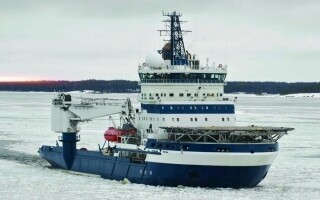
Finland, which launched its first icebreaker in the 1930s, has mastered the art of building these ships and has become a global leader in the field. The American interest in this sector is not new; even during his first term, President Donald Trump sought to address this critical issue by purchasing from Finland. According to Jason Muir, these talks have accelerated with the Scandinavian country's recent accession to NATO. A defense expert believes the alliance has become 'more prepared' to operate in a region of 'increasing importance.' Although neither country has a coastline on the Arctic Ocean, where their icebreakers typically operate in the Baltic Sea, their vessels and experience in ice navigation make them strategic partners in the new polar arena.
Thanks to its leading shipyards, 'Arctic' and 'Rauma,' and a leading design company, 'Aker Arctic,' Finland has been able to sell its expertise in building and operating these giants to the world, and is now doing so with Washington. Finns take pride in building more than half of the icebreakers currently sailing the world.
The Arctic is a major prize, and Russia has the most military bases north of the Arctic Circle. For the United States, which currently has a very small fleet relative to its size and geographic proximity (only three ships), the government has begun to accelerate its pace to keep up. It aims to own more than 50 icebreakers in the long term and has recently signed an agreement with Finland to purchase 11 of these ships from the Scandinavian country.
'The Arctic is the arena where the world's great powers compete for resources, trade routes, and influence,' says defense expert Jason Muir of the Atlantic Council. 'I'm not saying we're heading toward a major conflict in the region, but it is certainly a region of increasing geostrategic importance.'
The United States has long suffered from a shortage of icebreakers. For Washington, Finnish technical expertise is a fast track to closing the gap with Russia, as achieving this domestically is impossible. And it is no coincidence that Finland was chosen to meet the United States' needs. Despite its small size and population of just over five million people, compared to the great powers, it has the largest fleet in the world with 12 icebreakers. Finland is the only country in the world where all its ports can freeze over in the winter.
Beyond that remote image, the region is now a focal point of economic tension due to its vast energy and mineral resources, and a geopolitical struggle for dominance among the great powers of the Northern Hemisphere. This race requires enormous naval power, and the large, expensive vessels have become necessary to carve a path through frozen waters.
The Arctic is a grand prize. For Finns, the sea route is the only possible way to receive supplies during the cold months. Furthermore, about 80% of icebreakers were designed in Finland. Adding to these advantages is the recent clear rapprochement between Trump and Finnish President Alexander Stubb, a conservative who skillfully managed the relationship amid a flurry of attention and praise.
The White House has other advantages as well: while the technology is from the Scandinavian country, seven of the new icebreakers will be assembled on American soil in shipyards in Texas and Louisiana and will bear the 'Made in America' logo, as Trump promotes to his supporters, while relying on Europe for a strategically important maritime project.
Currently, Russia has the most military bases north of the Arctic Circle and a fleet of nearly 50 icebreakers, more than the entire NATO alliance. This fleet includes several nuclear-powered vessels equipped with atomic reactors, giving them far greater independence than diesel or natural gas-powered ships.
China, although much further away geographically, positions itself as a 'near-Arctic state.' This Asian great power has four of these ships in service and another under construction. Therefore, their survival depends on their ability to keep their waters navigable. 'They needed to catch up after decades of lagging in this area,' Muir explains.
The Arctic is no longer a distant and hard-to-reach area but has become a tangible reality for ordinary people.