


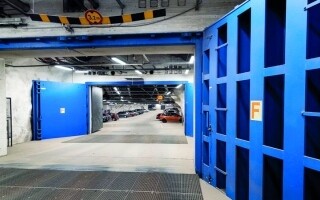
In the center of the Finnish capital Helsinki, children are playing football in closed facilities in an underground shelter. The name of this shelter, called Mireyhaka, is located in the Mireyhaka area and includes a café, a playground for children, a volleyball area, a gym, and a field for playing 'corfball'—a sport similar to hockey. There is also a parking area for a hundred cars, as well as all the necessary facilities for accommodating thousands of people in case of war or an extraordinary situation.
Access to the Mireyhaka shelter, established by the municipality in 2003, is through a lift from the street that leads to the parking area and sports facility. In the event of a conflict or crisis, metal leaflets are used for the movement of people.
The Mireyhaka shelter, constructed of granite slabs and occupying an area of 14,750 square meters, can be transformed into a shelter for 6,000 people in less than 72 hours. The solid white walls lead to the main blocks, each containing 2,000 beds made of fabric, accurately folded and placed in layers, while on the neighboring section, yellow panels on the ceiling indicate where 400 portable toilets should be installed.
Protection Strategies
A network of shelters in Finland began to be built in the past century, and since then it has been constantly expanding and updating. Since the beginning of the war in Ukraine in February 2022, Finnish authorities have intensified measures to support readiness due to the increasing threat from Russia, and currently, there are 50,500 shelters distributed across the country.
Anna Lehtenantta, responsible for the connection in the rescue administration of the Finnish capital, emphasized that in case of an emergency, the population is required to go to designated shelters, carrying with them provisions (there are no kitchens in the shelters), clothing and bedding, while pets will not be allowed. Lehtenantta pointed out that in Mireyhaka, there are guests, and their number amounts to 6,000 people, divided into three groups, which will work every eight hours, divided into three shifts: rest, work, cleaning, and other tasks, as well as free time.
Finland, a member of the European Union and NATO, has the longest border with Russia, exceeding 830 miles. Over the decades of Finnish neutrality since the Cold War, the country has remained prepared, although it has maintained neutrality. Mikke Antila, a deputy to the Head of Policy at the Ministry of Foreign Affairs, noted that Finns have never been afraid of Russia but have always remained vigilant and ready.